Search Society Blog

Friday, May 4, 2012

Introduction and Discussion Questions for our May 10th Meeting

That Hideous Strength

INTRODUCTION: “Tidies and fuglemen…………I sheel foor that we all – er- most steeply rebut……..Vood wooloo…Bot are you blammit?........Bundlemen, bundlemen……..Eh? Blotcher bulldoo?” I couldn’t resist beginning with some of the results of the curse of Babel on those esteemed masters of bureaucratic bull do-do, the leaders of NICE. (National Institute for Coordinated Experiments, ostensibly applied science for the greater good of all, but actually a front for sinister supernatural forces, the Macrobes.)

That Hideous Strength (THS), published in 1945, is the third and longest, book in CS Lewis’s space trilogy. Unlike Out of the Silent Planet and Perelandra, all the action takes place on planet earth. This time Ransom stays home and the planetary beings visit him- and also Merlin. As described by the author, THS is a modern fairy-tale for grown-ups. In the preface, he writes:”This is a tall story” about devilry, though it has behind it a serious ‘point’ which I have tried to make in my Abolition of Man…the outer rim of that devilry had to be shown touching the life of some ordinary profession. I selected my own profession, not….because I think fellows of colleges more likely to be corrupted than anyone else, but because my own is the only profession I know well enough to write about.”

Lewis credits conversations with a scientific colleague for sparking one of the central ideas of the tale. This inspiration was later enhanced by the works of Olaf Stapledon. Lewis said that he admired Stapledon’s invention, though not his philosophy. The influence of Lewis’ friend, Charles Williams, is also evident- especially in the Arthurian elements.

Note: The first-time reader of THS may feel overwhelmed by the numerous elements and characters as well as the frequent back and forth from the two main characters and two main settings. Wikipedia has an 8 page article on THS which provides plot summary, context in Space Trilogy, and brief descriptions of the characters. Although I have read THS several times, I still found this helpful, despite a few minor errors.

DISCUSSION QUESTIONS:

1. One of the main points in The Abolition of Man is that modern education and philosophy tend to create “men without chests”, or people lacking in discernment, loyalty, the ability to distinguish between good/bad; straight/crooked; right/wrong, etc.; not having the courage of their convictions, nor even any fixed convictions. The story line in THS alternates between the different paths of Mark and Jane Studdock, who have had thoroughly modern educations and pride themselves on being progressive. In what ways do Mark and Jane illustrate the idea of “men without chests?”

2. THS has remained in print since its first publication (1945) and has many devotees who re-read it regularly, finding something new and thought-provoking in it each time. Others, like George Orwell (author of another modern classic, 1984), have found much to like in THS, and much to dislike. Below are some excerpts from a variety of reviews. Which statements would you endorse?

“a morality tale about the dangers of unchecked ambition, a modern day Tower of Babel, a warning that totalitarianism can take many forms….rather than a seamless whole …more the quality of patchwork…maybe it’s not great literature, but – I really liked it.
[it has] shrewdness about human nature and human institutions…and a wicked sense of humor.”
“ a clever attack on moral relativism.”
“I do find the whole Arthur and Merlin thing a rather disappointing way to end it.”
“quite different from the first two books, both better and worse … more down to earth in the two main characters and presents the temptation of Mark ….believably.”
“more timely today than when the book was published….a thrilling story that I enjoy more each time”
“the action is contrived, the characters one-dimensional, and the tone didactic”
“a realistic description of what eventually happens when people make technology their lord”
“Lewis at his satirical best- an uppercut landed to the jaw of secular, anti-family, “post-Christian” society”
“too many words, Clive, too many words”

3. “Matrimony” is the first word in THS, as Jane Studdock contemplates her own marriage- expectations, disappointments, frustrations. THS ends with Jane walking toward the lodge where her husband Mark waits for her. In between there is much talk about marriage and gender roles, hierarchy, duties, promises, obedience. What is your reaction to the “old-fashioned ideas” of the Director (Ransom/ Mr. Fisher-King) and his Masters? How does Jane react? Why did Jane, an avowed feminist, choose the poetry of John Donne as the subject of her thesis? (see Donne quote beginning ‘Hope not for minde in women…”p. 16)

4. Mark and Jane do eventually end up in the same place (at least for the night) after parallel, but quite different, journeys. In what ways do each of them under-go re-education? Is there genuine transformation and/or redemption?

5. What makes Mark so vulnerable to the lure of “that hideous strength?” How does he over-ride his own misgivings and fears? In contrast, Jane is initially repulsed by her own non-returnable “gift” of vision and the invitation to join the group (or company) at St. Anne’s. (p. 61-68, 112-17) What finally draws her in?

6. What leads Mark to try to escape from Belbury? (page 259 on)What happens next? What leads him to finally, irrevocably, rebel? What form does his rebellion take? What role does the tramp play in this? (page 259 on, especially 311-14)

7. One might say that Mark and Jane, for much of the book, inhabit different worlds. Mark is drawn into the inner circle of NICE, located at Belbury. Jane is drawn into the smaller and much nicer circle located at St. Anne’s. What are the differences between the two worlds (Belbury and St. Anne’s) in the following areas: (a) methods of maintaining order and securing obedience (b) ambiance / atmosphere (c)gardens (pages 61-62; 101-02) (d)leadership (e) view of death (p. 229-30, 233; for Filostrato’s extreme views,p. 174)) (f)the rooms in which new members are initiated (p. 142; 296-299) (g) clarity vs. confusion (h) honesty vs. dishonesty (i) free, informed choice vs. coercion

8. The tramp (whose clothes Merlin took) is presumed by the leaders of NICE at Belbury to be the real Merlin, fresh from Arthurian times after a LONG sleep. Why is Wither (the DD) so puzzled by the tramp? (p. 313-14) What is the tramp’s reaction to the Banquet at Belbury? (p. 343-45) Why does the real Merlin join forces with the group at St. Anne’s?

9. Ransom, the hero of the first two books in the trilogy, plays a smaller role in THS. Why is he also called Mr. Fisher-King or the Pendragon? What is Logres?

10. If one could ever pin down the leaders of NICE to definitions, how would they define: progressive element; diehards; sound men; experiment vs. experimental; red tape; remedial treatment; elasticity.

11. Do you have a favorite quote from THS? Favorite character? Favorite scene?

Friday, April 13, 2012

"That Hideous Strength" Is Our Book for May 10th

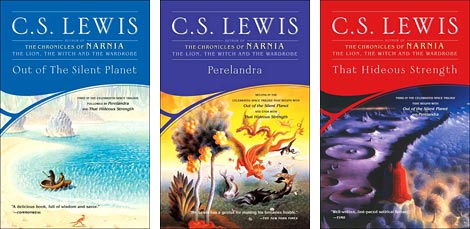
May 10th will find Peggy leading our discussion on the third and final volume of C.S. Lewis's Space Trilogy.  That Hideous Strength was published in 1945 and continues the adventures begun in Out of the Silent Planet, and continued in Perelandra.   But now we are involved on earth in the ominous rise of an inner ring that seems dedicated to evil and motivated by dark forces.  Elwin Ransom appears again leading a small group combating the rise of evil. 

This volume of the Space Trilogy illustrates the point of Lewis's non-fiction work, The Abolition of Man.  Come and join us at the Harrisonburg Barnes and Noble on the second Thursday of May at 7:30 p.m. and we'll be discussing this remarkable book.

Then in June we'll be reading The Abolition of Man with That Hideous Strength still fresh in our minds and we'll hopefully be able to get insight into what was troubling C.S. Lewis about our modern society.  Our schedule for the rest of the year is given below. (There may be changes in the schedule.  In particular we are considering changing the book for July to one of George MacDonald's novels, so stay tuned.)

Schedule for the Remainder of the Year


May 10: "That Hideous Strength" by C.S. Lewis with Peggy leading.
June 14: "The Abolition of Man" by C.S. Lewis with Ray leading.
July 12: "At the Back of the North Wind" by George MacDonald with Elizabeth leading.
August 9: "The Chronicles of Narnia and Philosophy" edited by Gregory Bassham and Jerry L. Walls with Jane leading
September 13: A Father Brown Story by G.K. Chesterton to be announced with Cristabel leading.
October 11: "The Last Battle" by C.S. Lewis with Iain leading.
November 8: "Descent into Hell" by Charles Williams with Melissa leading.
December 13: PARTY and Plotting the New Year
January 10, 2013: "Between Heaven and Hell: A Dialog Somewhere Beyond Death with John F. Kennedy, C. S. Lewis & Aldous Huxley" by Peter Kreeft with Peggy leading.

Friday, March 16, 2012

Perelandra — Thursday April 12th

The continuing adventures of Elwin Ransom who receives a mission from the Archon of Malacandra, the Oyarsa who he met on Mars (Malacandra) and who now sends him to Venus, known as Perelandra, where he encounters a world in the act of becoming and a mysterious green lady and her consort, the king.

Join us at the Harrisonburg Barnes and Noble as we explore this second volume of C.S. Lewis's space trilogy.  Jessica will be our leader and discussion questions will be posted here as the meeting day approaches.  If you'd like to be on the mailing list for the society please email the C.S. Lewis Society of Harrisonburg and mention you'd like to be on the list.  The society meets each month on the second Thursday at 7:30 p.m. at the Harrisonburg Barnes and Noble.  See you there!

Perelandra Questions for April 12th

Skipping long boring prelude .... here are all the questions for Perelandra by C. S. Lewis (page numbers in parentheses):

  1. How long did it take you to figure out that Lewis was talking about himself at the beginning of the book? (22)
  2. Discuss the description of Lewis' journey to Ransom's house. (10-20)
  3. Discuss the description of Perelandra given right after Ransom's landing there. (34-44)
  4. What did you think of the first meeting of the green lady and Ransom?
    • his surprise that she was a she
    • her laughter
    • her "I was young" comments
    • the obvious connection with Maleldil that she had
    • his lie to her and its effect on him
    (59-71)
  5. At the beginning of chapter 6 there is a description of pressure. Did it remind you of anything?
  6. When Ransom and Weston were speaking after they met on Perelandra, what did Weston say his mission was? (91)
  7. In the middle of page 96 what is it that happens to Weston?
  8. What is it that causes Ransom to know why he has been sent to Perelandra? (108-111)
  9. Discuss Ransom's train of thought that brought him to the realization of what he had to do? (140-150)
  10. What did you think of all the temptations? Did they remind you at all of Screwtape?
  11. How, in the end, did Ransom kill Weston? (181)
  12. What did you think of the descriptions of the two eldila —Malacandra and Perelandra? (193-202)
  13. Does Ransom's bleeding heel make you think of anything?
  14. Did reading this book affect you in any way?
  15. What is your opinion of Perelandra (the book)?
©2012 —Jessica Schneider

Tuesday, February 28, 2012

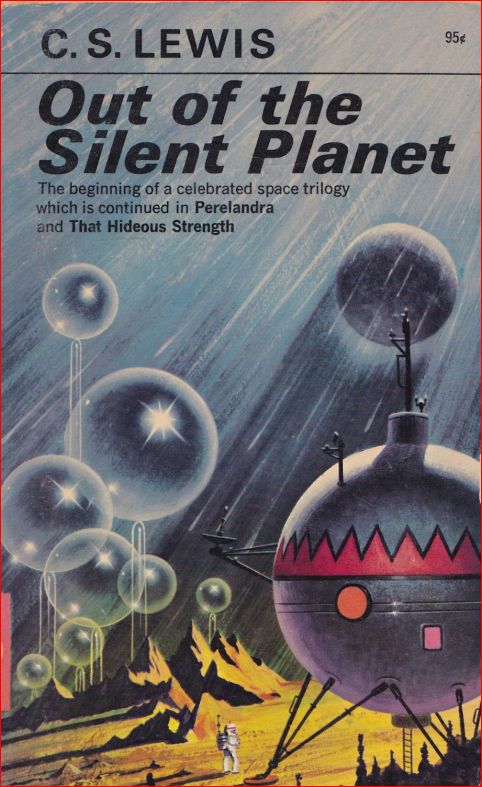
Out of the Silent Planet — Thursday March 8th

We'll be meeting on March 8th at 7:30 p.m. at the Harrisonburg Barnes and Noble.  In the meantime you might enjoy listening to a pod-cast about "Out of the Silent Planet" which you can find HERE  It is 34 minutes long and does a nice job of summarizing the book which might be good as a refresher before you come to the meeting.  I'll be posting the discussion questions here soon as well.


Discussion Questions for Out of the Silent Planet March 8th 2012

Background:

C. S. Lewis was a science fiction fan.  He was born in 1898 so much of the science fiction he was familiar with had a good deal of fantasy in it.  He cut his teeth on H.G. Well’s science fiction and on the popular pulp magazines that carried science fiction but these only came along after he was out of college.  C.S. Lewis and J.R.R. Tolkien became fast friends at Oxford after Lewis obtains a fellowship in 1925.  They met regularly in Lewis’s rooms together with other friends and this informal group came to be known as the Inklings.  “Tolkien and Lewis shared the belief that through myth and legend—for centuries the mode many cultures had used to communicate their deepest truths—a taste of the Christian gospel's "True Myth" could be smuggled past the barriers and biases of secularized readers.”[1]  They decided that they would have to write the kind of stories they would like to read and made an agreement that Jack would write a space travel story and Tollers, as Tolkien was called, would write a time-travel story.  Out of the Silent Planet and later Perelandra and That Hideous Strength were the result.

Discussion Questions:

1. What is the combination of motivations on the part of Devine, Weston, and Ransom that get the story going?

2. What are the surprises that Ransom encounters on the voyage to Malacandra?

3. How is Ransom’s fear developed by Lewis on the voyage?

4. How would you express the philosophies of Devine and Weston?

5. The reader only gradually appreciates the scenery and characteristics of Malacandra.  Describe how the unfolding character of the descriptions affected you.

6. Describe how Thulcandra came to be known as the silent planet.  How does this account fit into Lewis’s mythology and align with other accounts of “bent-ness”?

7. Discuss the three hnau of Malacandra, the sorn that live in caves on the harandra and the hross that live on the handramit and the pfifltriggi who live in the lowlands, the old ocean beds of the planet.  Can you speculate about Lewis’s sources for some of these ideas?

8. How did the eldila and the Oyarsa impact the story?  What did you think of Weston’s reaction to the Oyarsa?

9. How would you describe Ransom’s development as a person throughout the story?

 [1] http://www.christianitytoday.com/ch/news/2003/aug29.html

Sunday, February 12, 2012

The Space Trilogy Begins March 8th

The adventure begins on March 8th at the Barnes and Noble in Harrisonburg at 7:30 p.m. We will beginning a journey that will be extended for three months as we enter the imagination of C.S. Lewis's Space Trilogy.

WIKIPEDIA discusses The Space Trilogy with a little background. Lewis was always a science fiction fan, but not so much of what he called the gadget or "engineering fiction." Instead, for Lewis, science fiction was a vehicle for "supposals" that would take you away from your common everyday world into a world that asks you "to suppose" for example that the Medieval worldview was right afterall and the universe was looked over by spiritual beings. This is, of course, only an element in Lewis's supposal in the space trilogy. We will start with Out of the Silent Planet in March which takes us to Mars, and then on April 12th we'll continue to Venus where our hero Ransom enters a different kind of paradise, and then we'll finish the space trilogy on May 10th with That Hideous Strength set on earth, an earth you may recognize in many ways. Lewis said that That Hideous Strength was a fictionalization of the ideas in The Abolition of Man so right after we've done That Hideous Strength we'll read The Abolition of Man so that with the last volume of the space trilogy still fresh in our minds we can see the parallels that Lewis has drawn more clearly.
BARNES AND NOBLE or AMAZON can have the book to you in now time. Read this first volume of C.S. Lewis's space trilogy and come join us in March.

Tuesday, February 7, 2012

Questions for February 9th "Tolkien Reader" Meeting


Questions for the February 9th Meeting on "The Tolkien Reader"


** The Homecoming of Beortnoth **
1) According to the fragment of the poem now called The Battle of Maldon, what were the last words of Beorhtwold, Beorhtnoth’s old retainer? What are their significance?
2) Why does Beorhtwold’s station make the principle he states more pure, clear, and profound? How can this have influenced Tolkien’s use of hobbits as heroic characters in The Lord of the Rings?
3) In Tolkien’s opinion, what other line is key to understanding the full force of the poem? How does this influence the “northern heroic ideal” and how does it impact the depiction of heroism in his works?
4) Compare and contrast Beorhtnoth’s death with the death of Thorin.
5) How did Theoden embody the “northern heroic ideal”?

** Tree and Leaf **
1) Tolkien seems to represent a sort of Old School Revival in reaction against a pernicious New School phenomenon. What examples of literature best represent each approach to fairy-stories?
2) How is the origin of fairy-stories related to the origin of language?
3) How is the modern assumption that fairy-stories are for children related to similar attitudes that comic books and board games are “just for kids”? What is the consequence of this banishment to the nursery?
4) Why is it that a need for fantasy actually increases as we age?
5) What historical event served to awaken Tolkien’s desire for fantasy?
6) Why is drama inimical to fantasy? Do the technologies underlying modern cinema address this deficiency? Why or why not?
7) What assumptions underly Tolkien’s concept of “sub-creation” and how is it significant to the development of The Lord of the Rings?
8) What is “Real Life” as Tolkien’s opponents might define it? How could one legitimately desire to escape from it? How is this illustrated in The Lion, the Witch, and the Wardrobe?
9) According to Tolkien, what historical event explains the recurring themes of arbitrary prohibitions and fellowship with animals in fairy-stories?
10) What is “eucatastrophe” and how does it emerge in fairy-stories? According to Tolkien, how does this literary device correspond to reality?
11) How does Leaf By Niggle correspond to Tolkiens beliefs, aspirations, and his life? Would you say the story is metaphorical, allegorical, or something else?
12) Leaf By Niggle was written when Tolkien was not even halfway through writing what is now called The Fellowship of the Ring and Tolkien seems to have despaired of ever completing the work. If Leaf By Niggle is any indication, how did Tolkien expect his life’s work to be regarded after his death? Contrast this to how he is actually viewed today.

** Farmer Giles **
“This is the hour of the Shire folk, when they arise from their quiet fields to shake the towers and counsels of the great.” — The Lord of the Rings, Book II Chapter 2.
1) How well does the story Farmer Giles of Ham follow the precepts outlined in On Fairy Stories?
2) How does the tale incorporate elements of historical and geographical fact?
3) How does Farmer Giles primarily gain his experience points: for killing monsters, finding treasure, or selling magic items?
4) How does the ending of the story comport with the implied end-game of the early editions of Dungeons & Dragons?
5) Compare and contrast Farmer Giles with the heroes of The Hobbit and The Lord of the Rings.