Search Society Blog

Tuesday, February 28, 2012

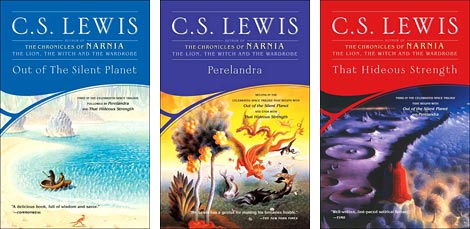
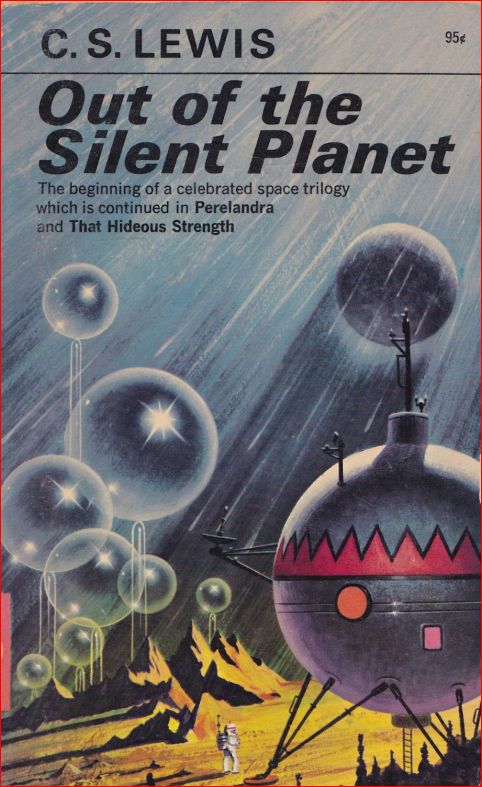
Out of the Silent Planet — Thursday March 8th

We'll be meeting on March 8th at 7:30 p.m. at the Harrisonburg Barnes and Noble.  In the meantime you might enjoy listening to a pod-cast about "Out of the Silent Planet" which you can find HERE  It is 34 minutes long and does a nice job of summarizing the book which might be good as a refresher before you come to the meeting.  I'll be posting the discussion questions here soon as well.


Discussion Questions for Out of the Silent Planet March 8th 2012

Background:

C. S. Lewis was a science fiction fan.  He was born in 1898 so much of the science fiction he was familiar with had a good deal of fantasy in it.  He cut his teeth on H.G. Well’s science fiction and on the popular pulp magazines that carried science fiction but these only came along after he was out of college.  C.S. Lewis and J.R.R. Tolkien became fast friends at Oxford after Lewis obtains a fellowship in 1925.  They met regularly in Lewis’s rooms together with other friends and this informal group came to be known as the Inklings.  “Tolkien and Lewis shared the belief that through myth and legend—for centuries the mode many cultures had used to communicate their deepest truths—a taste of the Christian gospel's "True Myth" could be smuggled past the barriers and biases of secularized readers.”[1]  They decided that they would have to write the kind of stories they would like to read and made an agreement that Jack would write a space travel story and Tollers, as Tolkien was called, would write a time-travel story.  Out of the Silent Planet and later Perelandra and That Hideous Strength were the result.

Discussion Questions:

1. What is the combination of motivations on the part of Devine, Weston, and Ransom that get the story going?

2. What are the surprises that Ransom encounters on the voyage to Malacandra?

3. How is Ransom’s fear developed by Lewis on the voyage?

4. How would you express the philosophies of Devine and Weston?

5. The reader only gradually appreciates the scenery and characteristics of Malacandra.  Describe how the unfolding character of the descriptions affected you.

6. Describe how Thulcandra came to be known as the silent planet.  How does this account fit into Lewis’s mythology and align with other accounts of “bent-ness”?

7. Discuss the three hnau of Malacandra, the sorn that live in caves on the harandra and the hross that live on the handramit and the pfifltriggi who live in the lowlands, the old ocean beds of the planet.  Can you speculate about Lewis’s sources for some of these ideas?

8. How did the eldila and the Oyarsa impact the story?  What did you think of Weston’s reaction to the Oyarsa?

9. How would you describe Ransom’s development as a person throughout the story?

 [1] http://www.christianitytoday.com/ch/news/2003/aug29.html

Sunday, February 12, 2012

The Space Trilogy Begins March 8th

The adventure begins on March 8th at the Barnes and Noble in Harrisonburg at 7:30 p.m. We will beginning a journey that will be extended for three months as we enter the imagination of C.S. Lewis's Space Trilogy.

WIKIPEDIA discusses The Space Trilogy with a little background. Lewis was always a science fiction fan, but not so much of what he called the gadget or "engineering fiction." Instead, for Lewis, science fiction was a vehicle for "supposals" that would take you away from your common everyday world into a world that asks you "to suppose" for example that the Medieval worldview was right afterall and the universe was looked over by spiritual beings. This is, of course, only an element in Lewis's supposal in the space trilogy. We will start with Out of the Silent Planet in March which takes us to Mars, and then on April 12th we'll continue to Venus where our hero Ransom enters a different kind of paradise, and then we'll finish the space trilogy on May 10th with That Hideous Strength set on earth, an earth you may recognize in many ways. Lewis said that That Hideous Strength was a fictionalization of the ideas in The Abolition of Man so right after we've done That Hideous Strength we'll read The Abolition of Man so that with the last volume of the space trilogy still fresh in our minds we can see the parallels that Lewis has drawn more clearly.
BARNES AND NOBLE or AMAZON can have the book to you in now time. Read this first volume of C.S. Lewis's space trilogy and come join us in March.

Tuesday, February 7, 2012

Questions for February 9th "Tolkien Reader" Meeting


Questions for the February 9th Meeting on "The Tolkien Reader"


** The Homecoming of Beortnoth **
1) According to the fragment of the poem now called The Battle of Maldon, what were the last words of Beorhtwold, Beorhtnoth’s old retainer? What are their significance?
2) Why does Beorhtwold’s station make the principle he states more pure, clear, and profound? How can this have influenced Tolkien’s use of hobbits as heroic characters in The Lord of the Rings?
3) In Tolkien’s opinion, what other line is key to understanding the full force of the poem? How does this influence the “northern heroic ideal” and how does it impact the depiction of heroism in his works?
4) Compare and contrast Beorhtnoth’s death with the death of Thorin.
5) How did Theoden embody the “northern heroic ideal”?

** Tree and Leaf **
1) Tolkien seems to represent a sort of Old School Revival in reaction against a pernicious New School phenomenon. What examples of literature best represent each approach to fairy-stories?
2) How is the origin of fairy-stories related to the origin of language?
3) How is the modern assumption that fairy-stories are for children related to similar attitudes that comic books and board games are “just for kids”? What is the consequence of this banishment to the nursery?
4) Why is it that a need for fantasy actually increases as we age?
5) What historical event served to awaken Tolkien’s desire for fantasy?
6) Why is drama inimical to fantasy? Do the technologies underlying modern cinema address this deficiency? Why or why not?
7) What assumptions underly Tolkien’s concept of “sub-creation” and how is it significant to the development of The Lord of the Rings?
8) What is “Real Life” as Tolkien’s opponents might define it? How could one legitimately desire to escape from it? How is this illustrated in The Lion, the Witch, and the Wardrobe?
9) According to Tolkien, what historical event explains the recurring themes of arbitrary prohibitions and fellowship with animals in fairy-stories?
10) What is “eucatastrophe” and how does it emerge in fairy-stories? According to Tolkien, how does this literary device correspond to reality?
11) How does Leaf By Niggle correspond to Tolkiens beliefs, aspirations, and his life? Would you say the story is metaphorical, allegorical, or something else?
12) Leaf By Niggle was written when Tolkien was not even halfway through writing what is now called The Fellowship of the Ring and Tolkien seems to have despaired of ever completing the work. If Leaf By Niggle is any indication, how did Tolkien expect his life’s work to be regarded after his death? Contrast this to how he is actually viewed today.

** Farmer Giles **
“This is the hour of the Shire folk, when they arise from their quiet fields to shake the towers and counsels of the great.” — The Lord of the Rings, Book II Chapter 2.
1) How well does the story Farmer Giles of Ham follow the precepts outlined in On Fairy Stories?
2) How does the tale incorporate elements of historical and geographical fact?
3) How does Farmer Giles primarily gain his experience points: for killing monsters, finding treasure, or selling magic items?
4) How does the ending of the story comport with the implied end-game of the early editions of Dungeons & Dragons?
5) Compare and contrast Farmer Giles with the heroes of The Hobbit and The Lord of the Rings.

Thursday, January 12, 2012

The Tolkien Reader is Our Book for February 9th

"The Tolkien Reader" will be our book for February 9th at our monthly meeting, 7:30 p.m. at the Harrisonburg Barnes and Noble.  Click on the image to go to the Barnes and Noble website or check out the Harrisonburg Barnes and Noble for a copy.  They took our book list for the year this evening and said they'd be getting some in.


The Tolkien Reader
This is a fun book.  It opens with a short essay by Peter Beagle on "Tolkien's Magic Ring" giving background on the "one ring to rule them all."  Then it contains the following material by Tolkien:
  • The Homecoming of Beorhtnoth Beorhthelm's Son
  • Tree and Leaf
    • On Fairy-Stories
    • Leaf by Niggle
  • Farmer Giles of Ham, and 
  • The Adventures of Tom Bombadil
If you have time certainly read the whole book.  If you are pressed for time you should read Tree and Leaf for sure.  Our meeting will be led by Jeff.

A special thanks to Jane who struggled to control our usual out of control boisterousness.  Melissa came up with a new title for herself as did Elizabeth, but I have thankfully forgotten what they were.  We should probably give more thought to special honorifics perhaps in the heraldry mold complete with coats of arms and blazons.  What fun!


Tuesday, January 10, 2012

Lewis Agonistes Questions! Meeting January 12th

Don't forget that we'll be meeting this Thursday at 7:30 p.m. in the Harrisonburg Barnes and Noble.  Our discussion topic for the evening is "Lewis Agonistes" by Louis Markos.  Jane will be our discussion leader.  The questions for the evening are listed below:


Lewis Agonistes by Louis Markos
Does Markos’ literary device of the character “Lewis Agonistes” work?
Chapter 1 - The Education of Lewis Agonistes
1.) The first chapter is largely biographical, is there anything here that changed your view or gave a new insight?
*2. How do Lewis's rational and imaginative sides both contribute toward the effectiveness of his apologetic works?
Chapter 2 - Wrestling with Science
*3 Which view ("top to bottom" or "bottom to top") do you find most persuasive? Why?
*4 What is C. S. Lewis's "argument by desire"?
*5 What does C. S. Lewis call the Tao?
*6 What reasons does C. S. Lewis give for religion not evolving?
Chapter 3 - Wrestling with the New Age
*7 According to Markos, what does the New Ager seek?
*8 What does Markos mean by the statement on page 72 that "Christianity is not the only truth, but it is the only complete truth"? Do you agree/disagree?
*9 Using the example of Emeth from The Last Battle (see pgs. 88-89), distinguish between universal salvation and the notion that those who earnestly seek will find. Here are some related scripture passages to consider: Matthew 7:21-23; Matthew 13:24-30; Luke 16:19-31; Jeremiah 29:13; Matthew 7:7-8; Hebrews 11:6
Chapter 4 - Wrestling with Evil & Suffering
*10 Markos makes the observation at the top of page 91 that "our modern Western world, which has seen a decrease in human suffering unparalleled in human history, seems less able to deal with pain and more quick either to blame God ... or to deny his existence altogether." Do you agree with the above statement? If so, do you have any theories why this might be the case?
*11. What two misunderstandings about our nature and relationship to God are at the root of our inability to deal with the problem of pain?
*12. For Adam and Eve it was the forbidden fruit, for the Lady in Perelandra it was sleeping on the fixed land. What is really at the heart of these seeming arbitrary commands?
Chapter 5 - Wrestling with the Arts
*13. What is the role or function of language? What can be lost if words lose their meaning?
*14. To what does Markos attribute Christians' reluctance to defend poetry from the attacks of postmodernism? Do you agree/disagree?
*15. How does the Incarnation refute Gorgias' (and deconstructionism's) three propositions?
*16. On page 131 Markos states, "when Christians gravitate toward a scientific reading of Scripture or betray a deep suspicion of the arts, . . they are embodying an ethos that is more Islamic than Christian." What do you think of this statement?
Chapter 6 - Wrestling with Heaven and Hell
*17. How did the Enlightenment ethos of equality affect the traditionally biblical notions of heaven and hell?
*18. Why is idolizing a "good thing" (such as mother love or patriotism) more likely to pull someone away from God than idolizing a "bad thing"? How can love become a demon?
*19. Markos defines love as "the movement out of narcissism" (p. 160). Do you argee with this, If so, how did/does God demonstrate his love per this definition?
*20. Distinguish between the views of heaven as mercenary wish fulfillment and heaven as the consummation of desire.
*21. What do you consider to be the greatest gift C. S. Lewis gave to our generation?
*Questions taken from CSL BOOK CLUB
Permission is given to make up to 30 copies of a study guide for noncommercial use with a small group, Sunday school class or educational class.


Friday, December 9, 2011

The Reading Schedule for 2012

C.S. Lewis Society of Harrisonburg Meets at the Harrisonburg Barnes and Noble the second Thursday of each month from about 7:30 p.m. until 9:00 p.m. See Schedule for 2012 below.

2012 Schedule
January 12: "Lewis Agonistes" by Louis Markos
February 9: "The Tolkien Reader" by J.R.R. Tolkien
March 8: "Out of the Silent Planet" by C.S. Lewis
April 12: "Perelandra" by C.S. Lewis
May 10: "That Hideous Strength" by C.S. Lewis
June 14: "The Abolition of Man" by C.S. Lewis
July 12: "Descent into Hell" by Charles Williams
August 9: "George MacDonald: An Anthology" edited by C.S. Lewis
September 13: A Father Brown Story by G.K. Chesterton to be announced
October 11: "The Last Battle" by C.S. Lewis
November 8: "The Chronicles of Narnia and Philosophy" edited by Gregory Bassham and Jerry L. Walls
December 13: PARTY and Plotting the New Year
January 10, 2013: "Between Heaven and Hell: A Dialog Somewhere Beyond Death with John F. Kennedy, C. S. Lewis & Aldous Huxley" by Peter Kreeft

Friday, November 25, 2011

Party December 8th "Lewis Agonistes" Postponed Until January

The regular December meeting of the C.S. Lewis Society of Harrisonburg would be on December 8th but the Barnes and Noble is having a Book Fair which always makes for a terrible meeting so at the November meeting we made two decisions: 1) We postponed Jane's leadership of "Lewis Agonistes" by Louis Markos to the January meeting on Thursday January 12th ..., and 2) declared a party at the Schneider's for the December 8th meeting.
PARTY AT THE SCHNEIDER'S 7:00 p.m. to 9ish or so on Thursday December 8th
Bring a Snack or Dessert to share.  If you want to drink something adult
BYOB ... I might offer a taste of Plum Wine for the adventurous.
Otherwise it's going to be water or lemonade.
ACTIVITY: Boisterous conversation and discussion of what we'll be reading and doing in 2012 beyond January.
PLEASE RSVP to schneirj@comcast.net or (540) 434-8284
For those who have not been here before, the location is:
77 Middlebrook St.
Harrisonburg, VA 22801

It's a green house with a big 77 on it that is the 4th on the left.
Middlebrook St.  is the last street off Central Ave. before you hit Pleasant Hill ... if that doesn't make sense Mapquest can find it.